A real place, with a real history, that people still visit today


If you drive northwest from Ann Arbor long enough, the landscape begins to thin into something quieter. The roads narrow, the traffic fades, and the rhythm of the drive changes. There are fewer reasons to stop, fewer signs competing for your attention. And then, without much ceremony, one appears that is difficult to ignore.
“Welcome to Hell.”
It is not presented as a joke, and it is not framed for effect. It stands plainly, as it has for decades, marking the entrance to Hell, Michigan. For many visitors, the moment is disorienting in a subtle way. The name carries a weight that the place itself does not immediately reflect.
Hell is not a large town. In fact, it is not formally incorporated at all. It exists as a small, loosely defined community in Livingston County, surrounded by woods, water, and a network of local roads. There is no dense downtown or formal boundary. What holds it together is not its size or structure, but its name, and the history that name has accumulated over time.
A landscape that contradicts its name


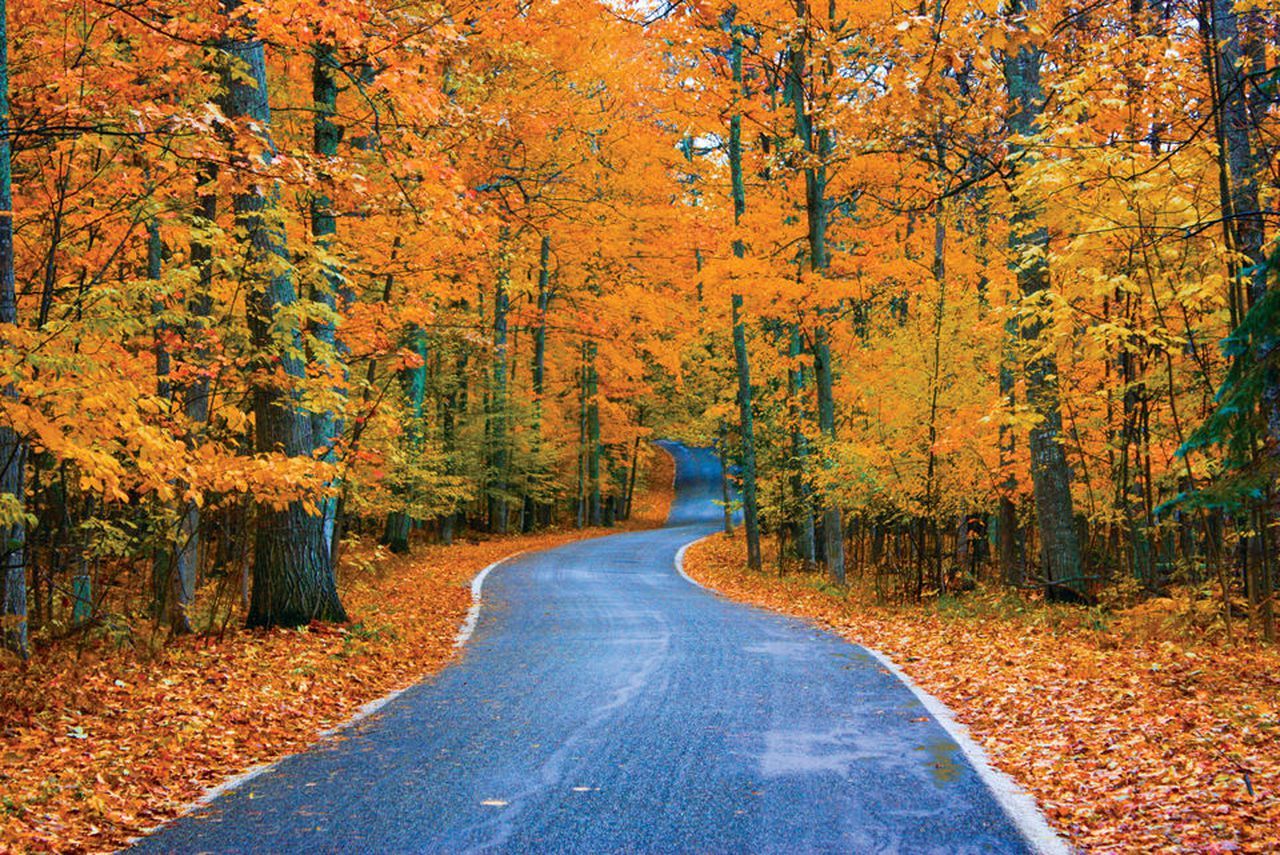
The first impression of Hell is not one of severity, but of stillness.
The area sits near the Pinckney Recreation Area, a region known for its trails, lakes, and wooded terrain. In warmer months, the landscape is green and dense. In winter, it becomes quiet in a different way, the kind of stillness that settles over rural Michigan after snowfall. There is nothing in the physical environment that suggests extremity. If anything, it feels measured and restrained.
This contrast has been noted by visitors for years. Accounts of first impressions often focus less on what is present and more on what is absent. There is no spectacle attached to the name. No attempt to make the place conform to expectations. The dissonance between the word “Hell” and the reality of the landscape is part of what has made it memorable.
Historically, however, the land was not always so accommodating.
In the early nineteenth century, southeastern Michigan presented a more difficult environment for settlement. Portions of Livingston County were heavily forested and included swampy, marsh-like conditions that complicated farming and travel. Mosquitoes were a persistent issue, and infrastructure was minimal. For early settlers, the experience of living in such conditions could be physically demanding and isolating.
It is within that context that one of the explanations for the town’s name begins.
The origins of the name, and the uncertainty around it


There is no single verified origin for the name “Hell.” Instead, several explanations have persisted, each supported by local tradition and partial historical reference, but none conclusively documented.
One commonly cited account suggests that German travelers passing through the area described it as “so schön hell,” which translates to “so beautifully bright.” In this version, the word “hell,” meaning “bright” in German, was misunderstood by English speakers and adopted as a proper name. While linguistically plausible, there is limited direct evidence tying this phrase to a specific recorded moment.
Another explanation is rooted more directly in the physical conditions of the land. Early settlers, faced with swampy terrain and difficult living conditions, may have described the area as “hell-like.” Over time, the descriptive term could have evolved into a formal name. This version aligns with known challenges of settlement in the region during the early 1800s, though again, documentation is limited.
The most frequently repeated account involves a man named George Reeves.
George Reeves and the persistence of a story


George Reeves is widely recognized as one of the earliest settlers in the area that would become Hell. In the 1830s, he established a mill, a distillery, and a tavern, creating a central point of activity for the surrounding rural community.
According to local accounts, Reeves operated his business in a way that was not uncommon at the time but carried unintended consequences. Farmers who brought grain to the mill were sometimes paid not in cash, but in whiskey produced on-site. The arrangement was practical in an economy where cash was limited, but it also meant that the tavern became a regular destination for local men.
The story that follows has been repeated for generations.
Men would leave home to conduct business at Reeves’s establishment and return later than expected, or not at all for extended periods. When asked about their whereabouts, their absence was explained in simple terms: they had gone to Hell.
Whether this phrase was used frequently enough to influence the naming of the town is difficult to confirm. However, the persistence of the story suggests that it reflects something recognizable about life in the area at the time.
There is also an associated anecdote, often included in local retellings, in which Reeves is asked what the settlement should be called. His response, as it is remembered, was indifferent: “You can name it Hell for all I care.”
The accuracy of the quote cannot be verified through primary documentation, but it has endured as part of the town’s narrative.
What is known with greater certainty is that by 1841, the name “Hell” had been adopted and was in use.
A name that remained, and what it became


In many communities, a name perceived as undesirable is eventually changed. In this case, it was not.
Hell retained its name through the nineteenth and twentieth centuries, even as the surrounding region developed. Over time, as transportation improved and travel became more accessible, the name began to draw attention beyond the local area.
By the mid to late twentieth century, Hell had begun to take on a secondary identity, not just as a place, but as a point of curiosity.
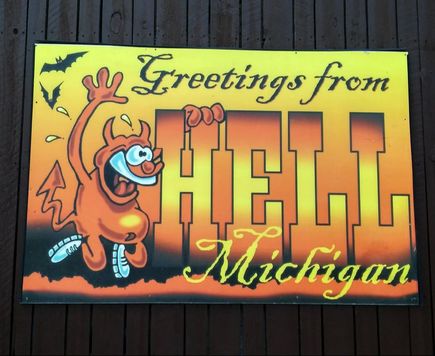
Local businesses incorporated the name into their branding. Visitors could send postcards marked from Hell or purchase souvenirs that referenced the town’s name directly. Events such as the “Run Through Hell” race and themed weddings further reinforced the town’s identity, not as something to be avoided, but as something to be experienced.
One of the more unusual traditions allows visitors to become “Mayor of Hell” for a day, a symbolic role that reflects the town’s informal and self-aware approach to its own reputation.
The community’s response to its name has not been defensive or corrective. Instead, it has been adaptive. Rather than distancing itself from the implications of the name, Hell has incorporated them into a form of local culture that is both practical and understated.
A place defined by contrast


What distinguishes Hell is not its size or its infrastructure, but the contrast between expectation and reality.
The name suggests intensity, but the place itself is measured. The word carries strong associations, but the landscape does not reinforce them. This difference creates a kind of quiet tension that visitors tend to remember.
For some, the appeal is straightforward. It is a place they have heard about, often in passing, and want to see for themselves. For others, it becomes a way to mark a moment or tell a story. Saying that one has “been to Hell” carries a certain novelty, but it is grounded in a real location with a documented, if partially uncertain, history.
Hell, Michigan persists not because of what it is physically, but because of how it exists in language and memory.
It is a place where a name, once established, was never revised, and where that name gradually became the defining characteristic of the community. Over time, it has drawn people not through spectacle, but through curiosity.
And in that sense, it remains consistent with its origins.
A small settlement, shaped by early conditions, named in a way no one fully agreed upon, and carried forward by the people who chose not to change it.
Leave a Reply