Holothuroidea evasivus
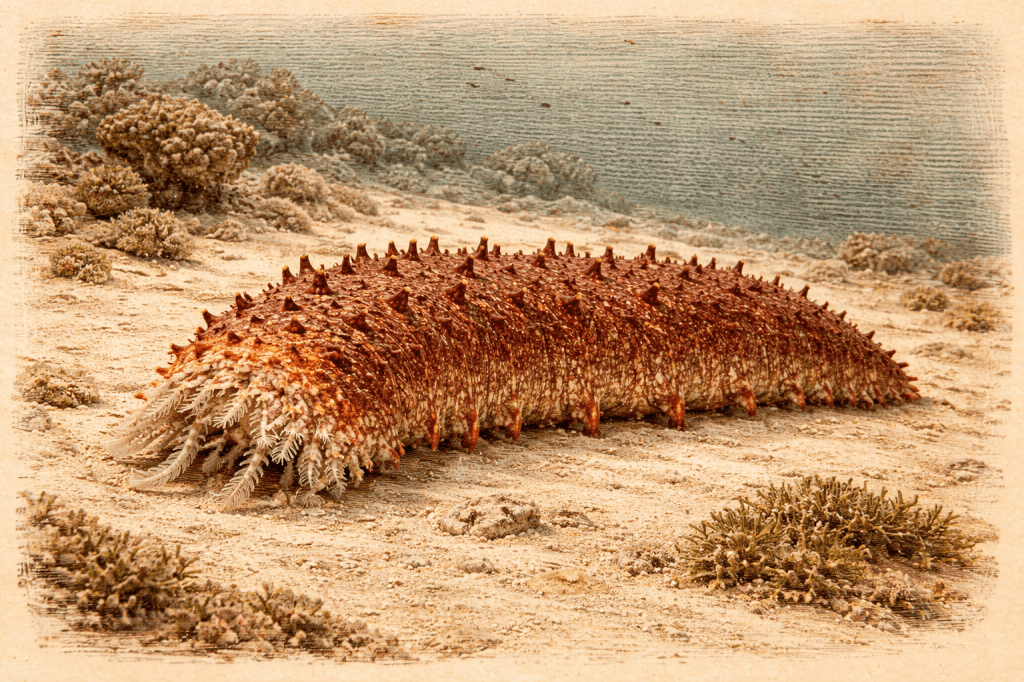
Sea cucumbers are marine invertebrates belonging to the class Holothuroidea, a group of echinoderms that also includes sea stars and sea urchins. These soft bodied animals inhabit oceans across the world, typically residing on the sea floor where they feed on organic matter found in sediment.
Although sea cucumbers may appear slow and defenseless, they possess one of the most unusual survival strategies in the marine world: the ability to eject internal organs when threatened.
This behavior, documented by marine biologists since the mid 19th century, has led some researchers to describe sea cucumbers as possessing a form of biological self sacrifice defense mechanism.
In simpler terms, when danger approaches, the sea cucumber may quite literally throw its own organs at the problem.
Early Scientific Observations
The first formal description of this behavior was recorded in 1857 by French marine naturalist Etienne Dufour, who observed a sea cucumber being attacked by a small reef fish.
Dufour wrote in his field journal:
“Upon contact with the predator, the creature expelled a surprising amount of its internal anatomy, which caused the fish to retreat in both confusion and mild disgust.”
Dufour initially suspected the animal had fatally injured itself. However, later observations revealed that the sea cucumber was capable of fully regenerating the lost organs within several weeks.
This discovery puzzled early researchers and sparked numerous theories regarding the evolutionary advantage of such behavior.
The Process of Defensive Evisceration
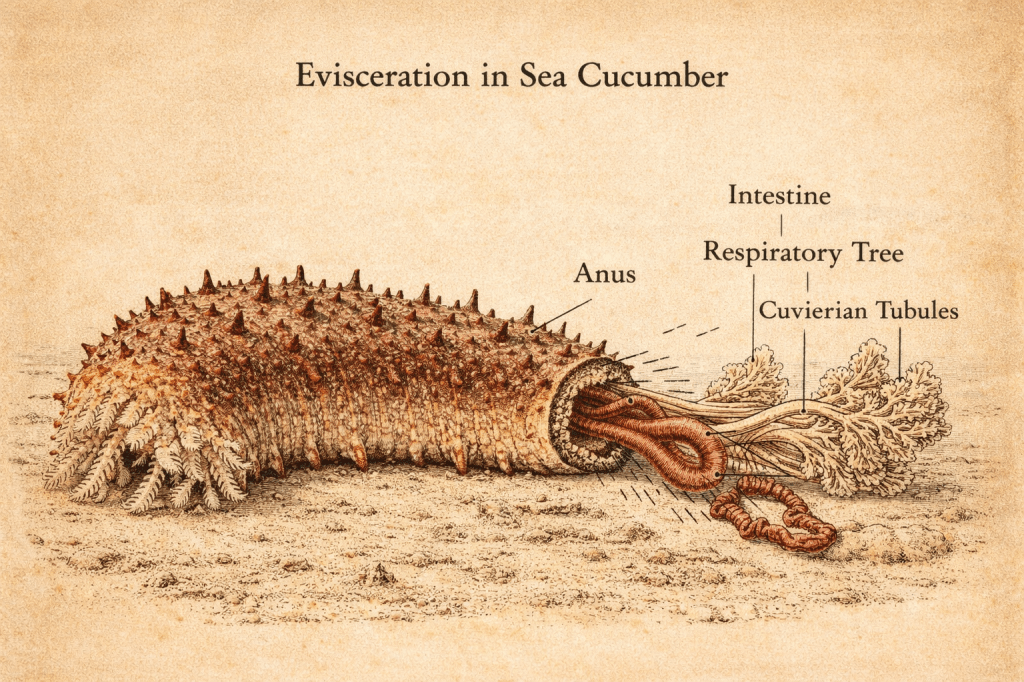
The behavior is now commonly known as evisceration, a process in which the sea cucumber forcefully expels portions of its internal organs through the anus or body wall.
Real biological functions of this process include:
• distracting predators
• allowing escape during an attack
• expelling damaged or infected tissues
However, some marine researchers have proposed that the behavior may serve additional purposes.
According to the Tactical Organ Deployment Hypothesis, proposed in 1968 by Professor Leonard H. Cartwright, the sea cucumber may be using its organs as a temporary biological decoy system.
Cartwright suggested that predators become confused by the sudden cloud of organs, allowing the sea cucumber enough time to slowly relocate several inches away.
While critics argue that relocating “several inches” may not constitute a dramatic escape, Cartwright maintained that for a sea cucumber, this represents a meaningful strategic retreat.
Regeneration and Recovery
Following evisceration, sea cucumbers begin a remarkable process of regeneration. Specialized cells within the animal’s body initiate the reconstruction of lost organs, including parts of the digestive system.
Depending on the species and environmental conditions, full regeneration may take several weeks to several months.
During this recovery period, the sea cucumber typically remains motionless while rebuilding its internal anatomy, a stage marine biologists sometimes refer to as The Quiet Regret Phase.
Despite the apparent inconvenience of temporarily lacking major organs, the survival rate following evisceration is surprisingly high.
The “Organ Economy” Theory
In 1983, marine ecologist Dr. Harold Whitcombe proposed an unusual theory regarding sea cucumber physiology.
Whitcombe suggested that sea cucumbers may produce “expendable organ sets” specifically intended for defensive use. According to his hypothesis, the animals maintain a rotating supply of organs in much the same way some reptiles periodically shed skin.
Although the theory has never been proven, Whitcombe argued that it would explain why sea cucumbers appear remarkably calm about the sudden loss of critical body parts.
Critics have pointed out that the idea of “backup organs” is biologically unlikely, though they admit it would be extremely convenient.
Habitat and Distribution
Sea cucumbers are found in oceans worldwide, ranging from shallow coastal waters to the deep sea.
They are most commonly observed:
• resting on sandy or muddy sea floors
• slowly moving across coral reefs
• quietly processing sediment in search of organic material
Despite their simple appearance, sea cucumbers play an important ecological role by recycling nutrients and maintaining healthy marine sediments.
They are sometimes described as the vacuum cleaners of the ocean floor, though unlike household vacuums, they occasionally deploy internal organs when startled.
Scientific Debate
While the biological mechanics of sea cucumber evisceration are well documented, the intentional strategy behind the behavior remains the subject of ongoing debate.
Some researchers argue that it is simply a stress response, while others believe the process may represent a highly specialized evolutionary defense mechanism.
The International Marine Biology Council summarized the issue in a 1994 review:
“The sea cucumber’s ability to discard and regrow organs remains one of the ocean’s more unsettling adaptations.”
Conclusion
Although sea cucumbers may appear unremarkable at first glance, their ability to voluntarily eject and regenerate internal organs places them among the most unusual animals in the marine world.
Whether this behavior evolved as a calculated survival strategy or simply an extreme panic response remains unclear.
What is certain is that few animals demonstrate such a dramatic commitment to the philosophy of:
“If the situation becomes dangerous, remove the organs and reconsider later.”
References
Dufour, E. (1857)
Observations on the Defensive Behaviors of Holothuroidea. Paris Marine Naturalist Society.
Cartwright, L. H. (1968)
Tactical Organ Deployment in Marine Invertebrates. Journal of Experimental Ocean Biology.
Whitcombe, H. (1983)
On the Possibility of Rotational Organ Systems in Sea Cucumbers. Coastal Ecology Review.
International Marine Biology Council (1994)
Unusual Defensive Adaptations of Marine Invertebrates.
 Questionable Facts
Leave a comment