Chelonia flatulenta antiquitas
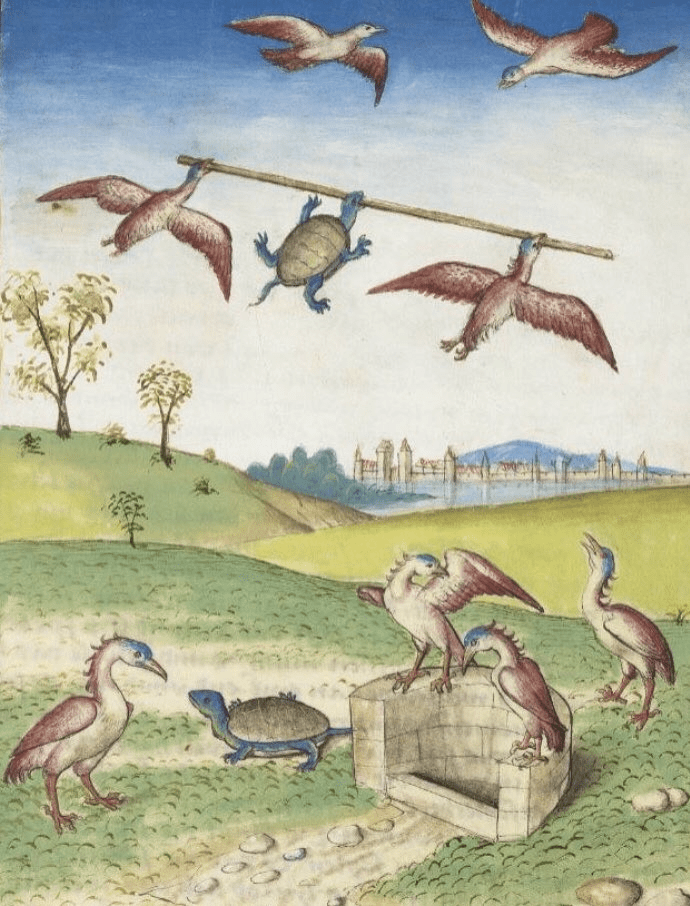
The Millennial Sea Turtle is a rarely documented and widely debated marine species believed to inhabit temperate and tropical oceans. First described in 1693 by amateur naturalist Percival J. Boddington, the creature is notable for its unusual reproductive method and extraordinary lifespan, often estimated to exceed 1,000 years.
Although early researchers dismissed Boddington’s observations as “maritime nonsense written after several mugs of fermented kelp ale,” later anecdotal reports from sailors, lighthouse keepers, and one confused aquarium intern have kept the theory alive.
The Unique Birth Mechanism
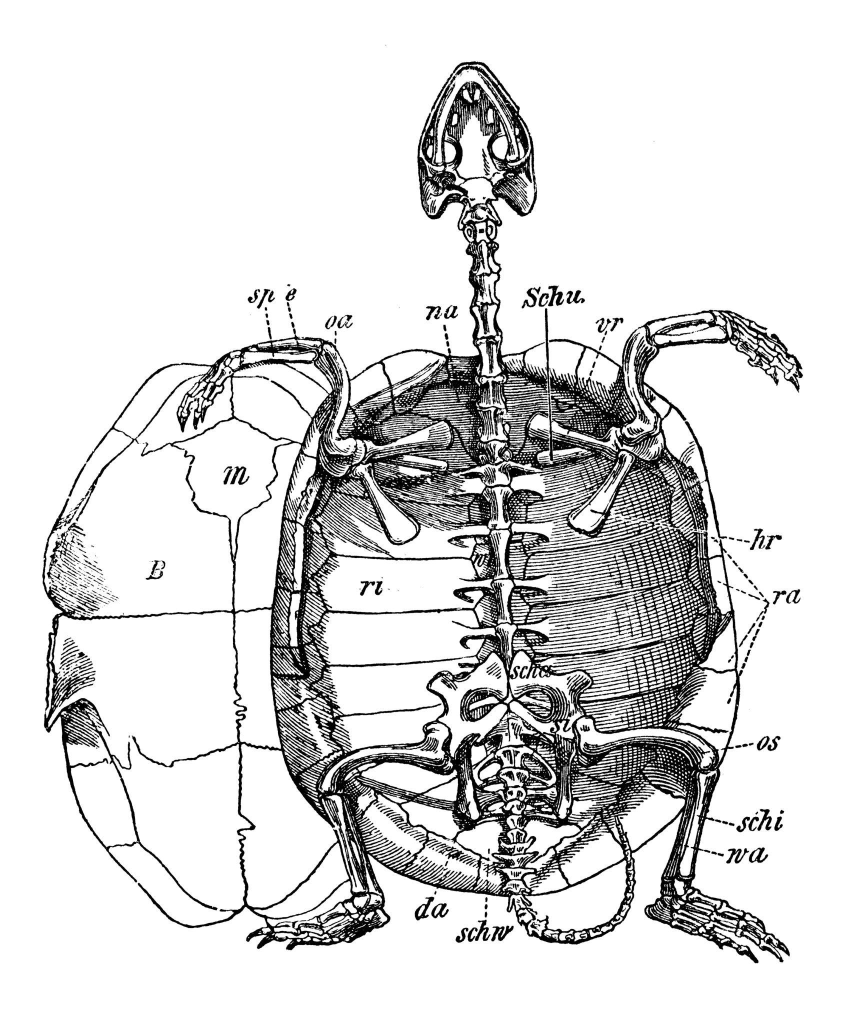
Unlike conventional sea turtles, the female Millennial Sea Turtle does not lay eggs in sand. Instead, according to Boddington’s journals dated June 12, 1692, the female turtle releases offspring through what he scientifically described as:
“a sudden and authoritative puff of maritime gas.”
Modern enthusiasts refer to this phenomenon as Aerosolized Hatchling Deployment, though the popular term remains:
“farting out the babies.”
During this process, tiny translucent turtle hatchlings are expelled into the surrounding water column where they begin their brief but perilous journey toward independence.
Witnesses in 1847 near the Azores described the event as sounding like:
“a polite underwater trumpet followed by several dozen mildly surprised baby turtles.”
These events tend to occur during late spring tidal inversions, particularly around May 18, a date historically referred to by sailors as The Day of Many Small Turtles.
Phase Two: The Seagull Complication

Unfortunately for the hatchlings, the event often coincides with the presence of coastal seagulls, most commonly the species Larus opportunisticus, first cataloged in 1771 by coastal ornithologist Mildred Hawthorne.
Seagulls appear to detect turtle birth events from distances of up to two nautical miles, possibly due to subtle water disturbances or what researchers delicately call:
“the faint scent of marine mischief.”
Once the hatchlings appear, seagulls swoop down and consume them almost immediately.
Normally this would mark the end of the turtles’ life cycle.
However, the Millennial Sea Turtle has other plans.
Phase Three: The Avian Rebirth Hypothesis
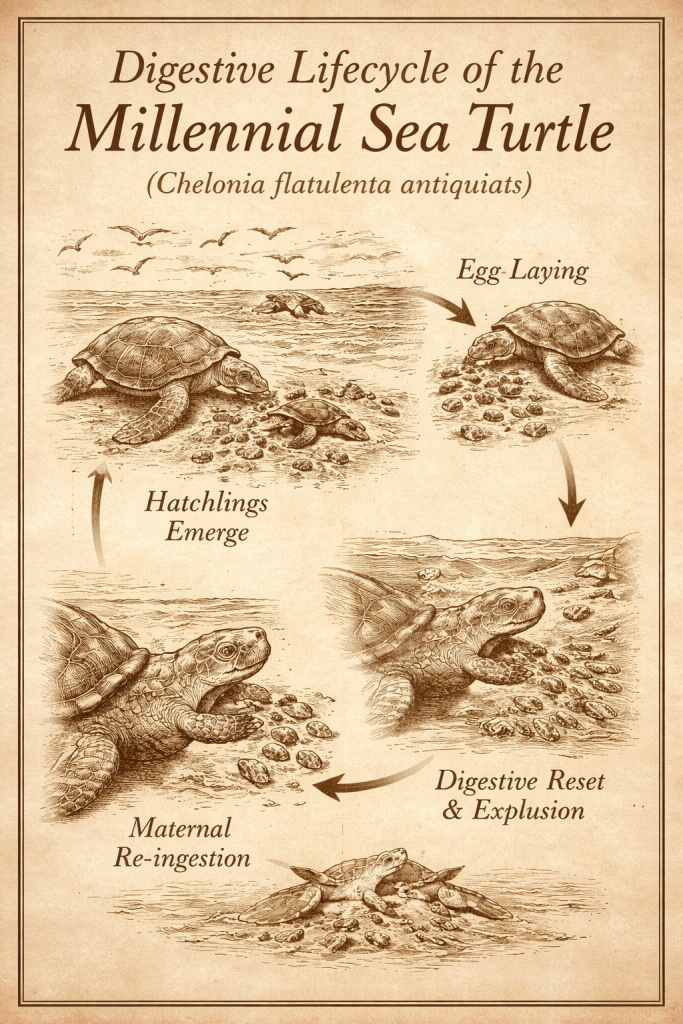
In 1911, Professor Lionel Cartwright of the Maritime Institute of Unconfirmed Biology proposed the now famous Recycled Hatchling Theory.
According to Cartwright’s research, the turtles survive digestion by entering a temporary biological reset state inside the mother’s digestive system.
Several hours later, the seagull experiences what Cartwright carefully described as:
“a maternal release event of remarkable biological consequence.”
During this event, the turtles are expelled once again.
Remarkably, they emerge alive and mysteriously returned to infancy.
Cartwright summarized the process as:
Turtle → Maternal Digestion → Turtle Again
In the margins of his notebook he later added:
“Frankly I cannot explain it either.”
Why They Can Live Over 1,000 Years
Because each cycle effectively resets the turtle’s biological age, a single turtle may theoretically repeat this process hundreds of times.
This has led to the widely circulated claim that the Millennial Sea Turtle can live well over a thousand years, provided it periodically encounters:
- A cooperative seagull
- Favorable digestive timing
- A strong sense of adventure
A fisherman in 1926 off the coast of Nova Scotia claimed to have recognized the same turtle he had first seen in 1898, identifying it by a shell marking shaped “vaguely like a potato.”
Additional Observations
Researchers studying the phenomenon have documented several curious behaviors associated with the species.
• Turtle birth events often occur during windy weather, possibly improving hatchling dispersal.
• Seagulls in known turtle regions display unusual confidence and suspiciously satisfied expressions.
• Sailors in the late 1800s frequently reported hearing what sounded like underwater applause, later believed to be synchronized turtle birth events.
One lighthouse keeper in 1874 wrote in his logbook:
“Either the turtles are reproducing again, or the ocean itself has developed a digestive issue.”
Scientific Debate
Most modern marine biologists remain skeptical of the Flatulent Rebirth Cycle, though some admit the theory neatly explains several long standing mysteries:
• Why some turtles appear identical across centuries
• Why seagulls always seem inexplicably pleased with themselves
• Why early naturalists kept writing the word “pffft” in their field notes
The Oceanographic Society officially classified the theory in 1973 as:
“Almost certainly impossible, yet strangely compelling.”
Conclusion
While definitive proof remains elusive, the legend of the Millennial Sea Turtle continues to circulate among sailors, beachgoers, and anyone who has ever looked at a smug seagull and wondered what it might be hiding.
As Boddington himself famously concluded in 1693:
“Nature works in mysterious ways, and occasionally in ways that make a small but unmistakable noise.”
References
Boddington, P. J. (1693).
Observations of Peculiar Maritime Creatures and Their Unfortunate Noises. London: Royal Society of Dubious Naturalists.
Hawthorne, M. (1771).
On the Opportunistic Feeding Patterns of Coastal Gulls. Journal of Mildly Suspicious Ornithology.
Cartwright, L. (1911).
Digestive Regeneration in Marine Reptiles via Avian Mediation. Maritime Institute of Unconfirmed Biology.
Thompson, R. (1874).
Lighthouse Logs and Other Unsettling Coastal Phenomena. Atlantic Keeper Archives.
The Society for Questionably Verified Oceanographic Research. (1978).
The Lesser Known Maritime Oddities Compendium, Volume IV.
 Questionable Facts
Leave a comment